The leaderboard
Rangliste — Hvem er på toppen
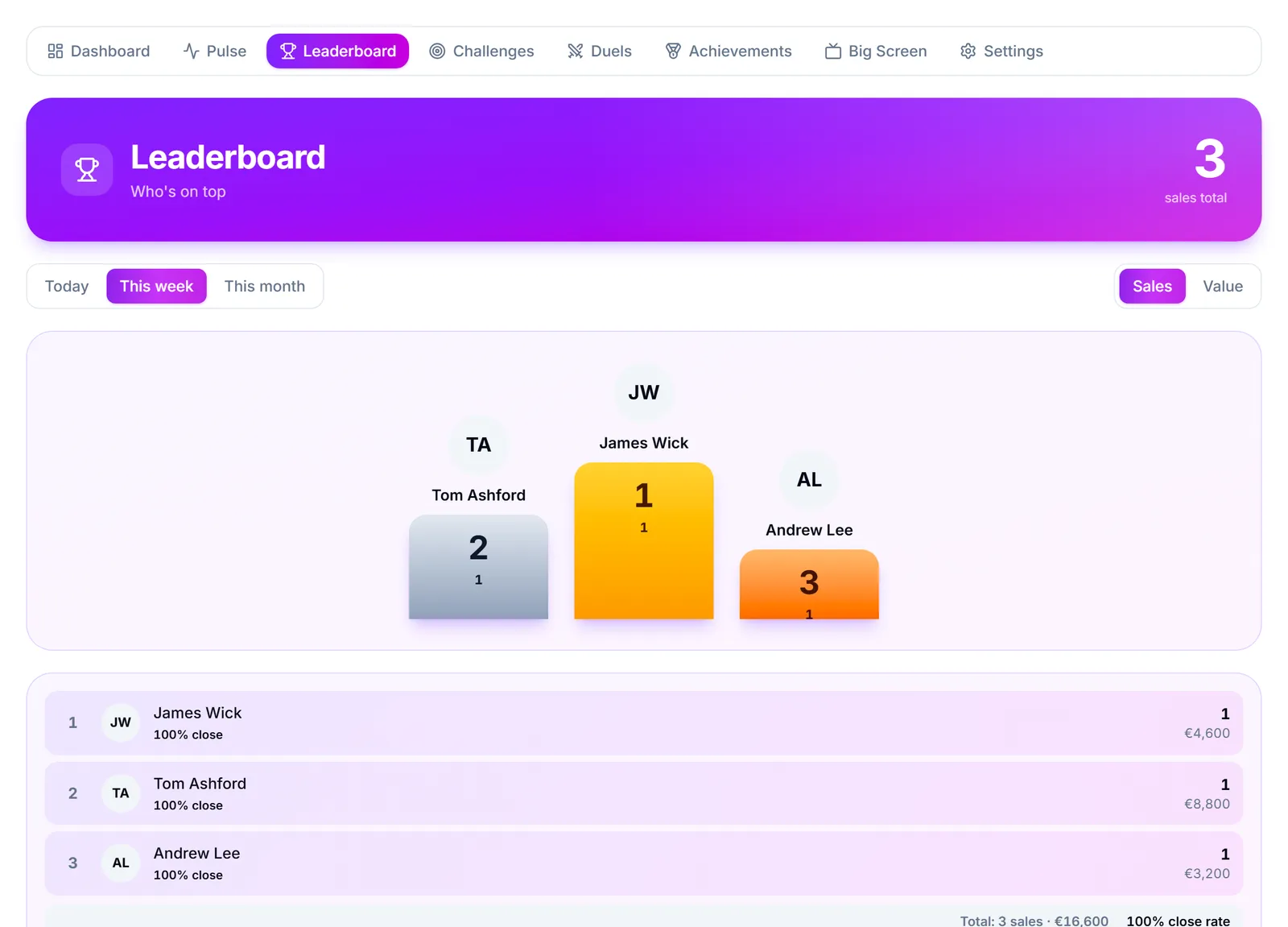
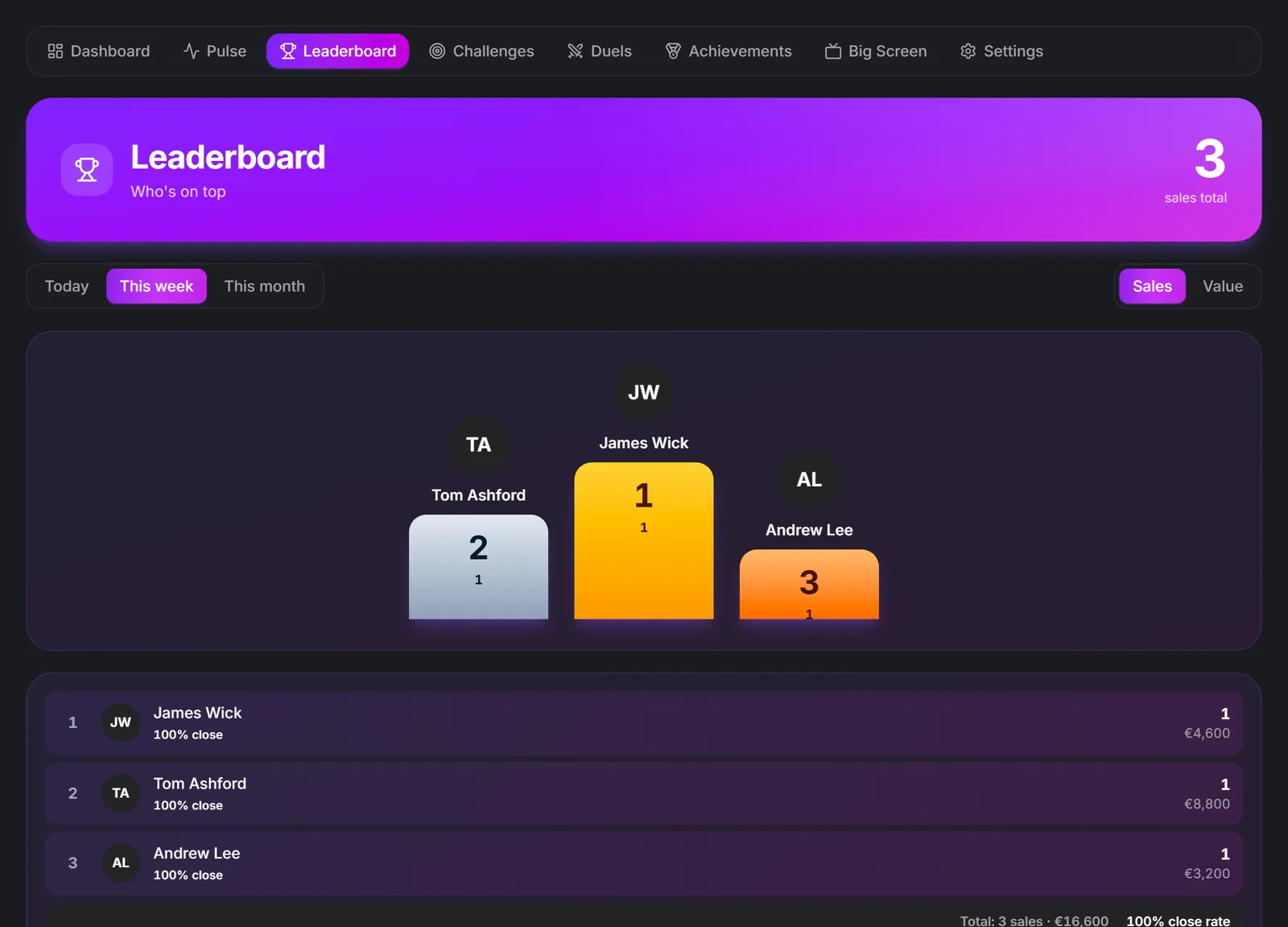
The columns are #, Sælger, Salg, Værdi and Stime, with I alt: {{sales}} salg · {{value}} underneath. Your own row is marked Dig.
Count and value are both there for a reason. Ranking on count alone rewards whoever chases small deals; ranking on value alone hides the person quietly closing steadily. Read them together, and look at {{rate}}% bekræftet andel and {{count}} åbne before drawing conclusions — someone the confirmed share describes the mix currently shown, not a seller's win rate. Lost deals are outside that active mix. Won or signed deals are counted when they became sales, while open deals are counted when they were registered; these are not a cohort of deals closed in the same period. Do not use this share to judge how often a seller wins against losses.
The board shows the top sellers only. Up to five people are listed, in the leaderboard, in the day-by-day view, on a challenge and on the Big Screen. Nobody is shown at the bottom of a list: a ranking that names the last person every week costs more in morale than it gains in competition. A team of three or fewer shows everyone, since there is no bottom to hide, and from four sellers up the last place is always held back. If you are not on the board yet, you see a private line saying how far away it is ({{count}} salg mere for at nå top {{visible}}). Nobody else sees that line. Everyone still counts in the company totals.
Hvordan tælles det? opens a short explanation of what this workspace counts as a sale, who gets the credit, which currency values are in and how many places the board shows, so a number can always be explained.
Stime is consecutive days with a sale. It is the number that rewards showing up, which is why it often motivates more than the totals do.
Dag for dag — Tryk på en dag for detaljer — breaks the period down, which is how you spot that a good week was really one very good Tuesday. Ingen salg denne dag. on a working day is worth a conversation.
Ingen salg i denne periode endnu. means no won or signed deals in the period, not a broken page. Check the period first, then whether deals are actually being marked won or in a configured contract-signed stage: Mark an opportunity as won.
Use it well. A leaderboard is motivating when everyone can plausibly move up it and the ranking reflects effort. It is corrosive when the same person wins every month by structural advantage — a bigger territory, better leads. If that is your situation, Duels between balanced teams works far better than an individual ranking.
Company totals and currencies
Deal values in different currencies are converted into the workspace currency before they are added or ranked. The same conversion is used for value-based challenges and duels. If a required exchange rate is unavailable, Momentum shows an error instead of presenting a partial or mixed-currency total.
Sales with no assigned seller still count towards company totals and company challenges, and remain visible in Pulse as Salg uden sælger. The leaderboard shows their count separately as {{count}} uden tildelt sælger. They do not receive a personal rank, badge or celebration, and they are not credited to another seller.
Confirmed orders and awards
When Momentum counts confirmed orders only, an order counts on the date of its first customer or manual confirmation. Registered-order scoring still uses registration day. Older confirmed orders without a confirmation date retain their registration day, so a later edit does not move a historical sale.
Afslutter rewards ten sales in one week. It is a volume achievement; it does not reward the largest deal value.
Var det her nyttigt?