Imagine that something is not working properly in your CRM. One of the fields behaves differently from what you expected, a report adds up wrong, or an automation sends an email to the wrong recipient. You call the consulting firm that set the system up for you, and you explain the problem as well as you can.
The person you speak to writes it down and says they will have to check with the vendor. A week later an answer comes back, and it does not quite fit. Either your question was simplified along the way, or the answer was. You explain it again, and you have to go through the whole process one more time.
Why nobody can give you an answer
It is tempting to explain this by saying that somebody is slow or uninterested, but that is rarely the case. More often the explanation lies in how the chain between you is put together.
The consulting firm did not build the product. They know your setup well, but they cannot say with any certainty why the system behaves the way it does, because they have no visibility into that. On the other hand, the vendor who built the product does not know your setup. They do not know which fields have been added, which rules have been switched on, or why somebody three years ago chose to solve it in exactly that way.
Both parties answer correctly within their own area. Your problem sits in the space between them, and that space belongs to nobody. That is why you end up feeling that no one can give you a complete answer, even when everyone you speak to is both competent and willing to help.
Why it costs more than you think
Let us be honest about one thing first: any change to a business system costs more than the work itself. Somebody has to understand what you want, somebody has to estimate it, somebody has to do the job, somebody has to test that it works, and in the end it has to be invoiced. That is true no matter who carries out the change, and it is not unreasonable.
The difference with a consulting firm in the middle is that every one of those steps gets a round trip.
You explain what you want to the consultant, who then has to put it into words for the vendor. The answer travels back along the same route, and on the way a nuance or two tends to disappear. Then you discover that something was lost, you clarify it again, and the round repeats.
This does not happen only once. It happens when the need is being mapped out, it happens when the price is being set, it happens while the work is going on, and it happens again when the result is not what you meant it to be.
So the middle link does not add an extra step to the process. It doubles every step that is already there.
Every round trip is hours that somebody puts on an invoice. Between the rounds the matter stands still, and a job that could have been done in two days stretches over three weeks. The details that disappear along the way have to be gathered in again afterwards, and then you pay for the same round a second time.
The most expensive bill is still not the one you pay. It is the changes you never ask for, because you already know what a small question is going to cost in both time and money.
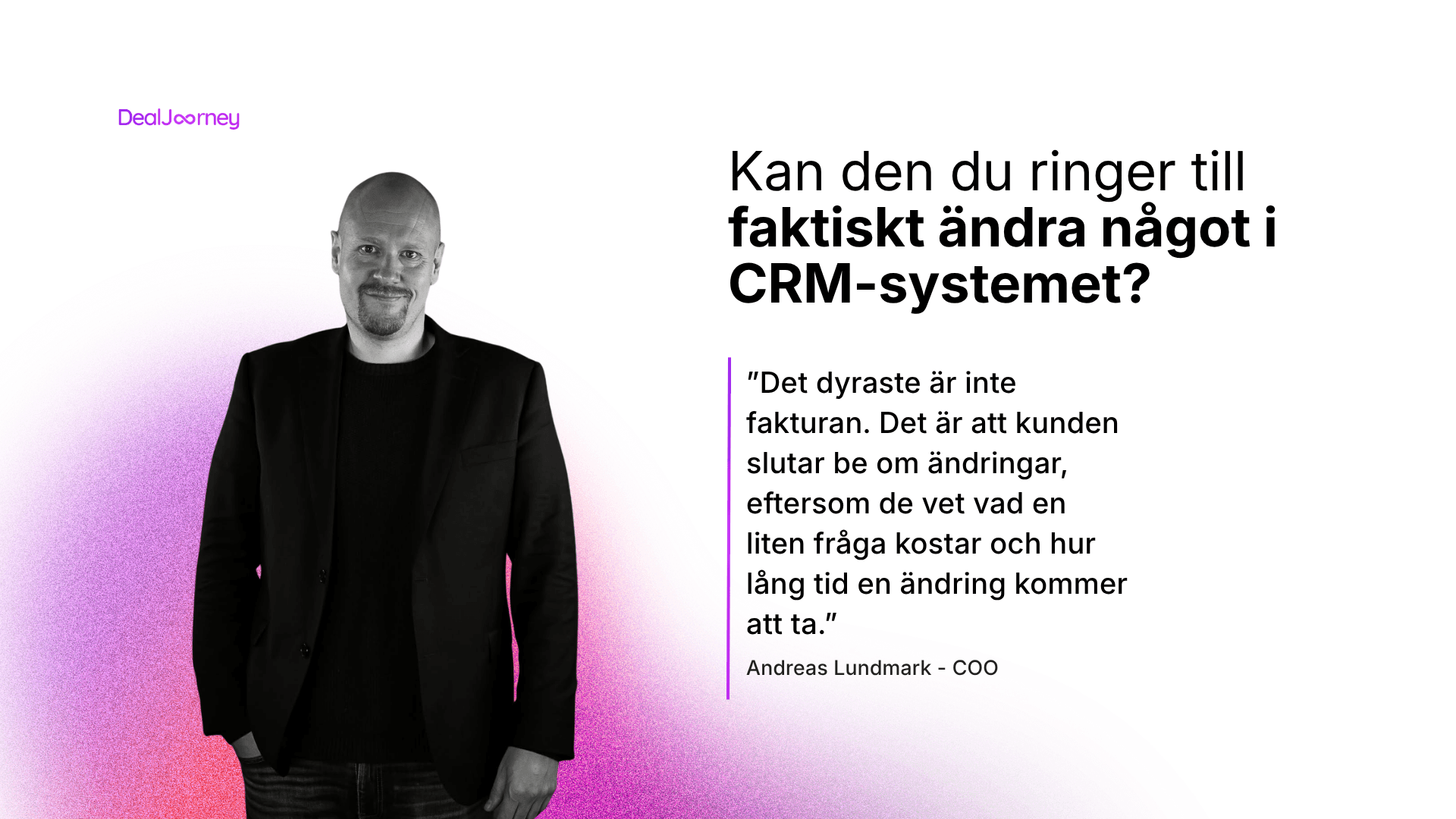
Andreas Lundmark, COO at DealJourney, has seen the same pattern many times over the years.
“I have seen implementation bills that were larger than two years of licence fees. But the most expensive part was not the invoice. It was that the customer stopped asking for changes, because they knew what a small question cost.”
In last month's article we wrote about the spreadsheet that appears next to the CRM, and that this spreadsheet usually turns up in the space between two or more systems that do not talk to each other. The same thing applies here, only with people instead of systems. The answer you never get appears in the space between two companies that are both doing their job.
The test: can the person you call change anything in the CRM?
There is one simple question that reveals how long the distance is in your own case.
Can the person you call actually change anything in the CRM?
If the person at the other end can make the change while the two of you are still talking, or at least tell you whether it can be done at all, the distance is short. If they have to check with somebody else, who has to check with another person before they can say anything, you have a middle link in the chain, and you will notice it every single time something is urgent.
When a middle link is worth the money
None of this means that consulting help is wasted. If you have to move fifteen years of messy data out of an old system, build integrations into an ERP system that nobody fully understands any more, or work out how the company should actually operate before anything is set up at all, that is work which calls for people who have done it many times before. It is worth paying for.
The line runs between paying for thinking and paying for access.
Where DealJourney fits in
With us you speak directly to someone who can make changes. If you call about something that is not working, you reach someone who knows the product inside out. There is no relay between a consulting firm and a vendor, quite simply because there is only one company to deal with.
That is how we work today, while we are still a small company, and we are aware that this closeness is something we will have to work at keeping as we grow. But it is a deliberate priority on our part, and not a coincidence. The faster you can get changes made, the easier it is for the system to keep up as you grow.
We also run pilots. We set up a defined part of your business in DealJourney, with real data and real users, so that you can see how the system behaves in your own process before you decide about the rest.
If something you need is missing, we build it. A pilot with us is not only about configuring what already exists, but about building the part that is specific to your case. This is where the difference from a middle link becomes clearest. A consultant can set up the product as it is, but only the people who built it can change what it actually does.
It also gives you a chance to think again. Instead of adapting the way you work to whatever the system happens to allow, you can decide how you actually want to work, and let the system follow. That is the opposite order of what most people are used to.
The scope, the duration and the terms are something we agree on together, and it is us you sit with along the way, not a third company.
Want to talk to someone who can actually change something? See how DealJourney works.

Benjamin Sagen
Marketing Manager at DealJourney